
Starseed Harmonies
Devlog 6 - Tutorial
I usually like to make games without tutorial. Or rather, a minimalist, hidden tutorial. I want the player to discover the rules by themselves. I do so by designing an intro restrictive enough so that players will perform by themselves the actions that will let them figure out how the game works.
Starseed Harmonies being a game about secrets, it was initially designed this way. Installing a sense of mystery right at the start seems appropriate! But I’ll explain here why this had to evolve, and how I wrote a non intrusive tutorial that still let the player assimilate the game by playing.
Tutorial 1 : Puzzle
Since Starseed Pilgrim, I enjoy a lot when understanding the game’s rules is a puzzle by itself. There’s a sense of childlike play when you encounter a weird system with no explanation, press random buttons, and try to figure out how it works. The tutorial becomes a small challenge by itself that feels rewarding when you understand how to “solve” it. I believe games are logic systems that make the players ask two questions: how does the system work, and what can the system do? Designing tutorials this way is a lot more interesting than textual explanation. And usually more efficient: players understand better by doing things and assimilating the rules with their own logic. I successfully implemented that design in several jam games.
The key to make those kind of tutorials work is by restricting the players’ actions so that they are forced to accomplish certain things. I only give them instructions for input (what buttons they can use), and sometime a vague hint, but reduce their field of actions so that they’ll eventually do the right thing (even if it’s out of boredom). You can see this in action in In Octave, To Take Off or Echoes Traveler. In each one of them, player is only able to do one thing in a restricted area. By fiddling enough, they can make out the mechanics and then progress further in the game.
To apply this in Starseed Harmonies, my idea was to make the player interact only with a small set of tiles. Not only would this create a consistent musical introduction, it would also make the player learn the language of the game: plant seeds, and collect them. The initial plan was to respect that order: have only 3 empty tiles available, forcing the player to click one of them to plant seeds. Then once they are grown, their only action would be to click again to collect the seeds. Only then would the other tiles be revealed. But this posed several problems. First, it would mean that the player already has some seeds in their inventory, which means that there would already be information on the screen given without context. Second, it doesn’t reflect how the game is played in the long term. It encourages player to plant and collect tiles one by one, which is not the desired way to play (the game feels better when several tiles are playing together). And it doesn’t introduce the notion of choice between the several tiles there can be in a grid. And third, it creates arbitrary exceptions that contradict some of the game logic, like the tiles apparition after the tutorial. Also, since Starseed Harmonies is a game full of secrets, players are expected to play it several times. Playing again this tutorial would be a waste of time for players who know how the game work.
So I went with the reverse instead: collect seeds, then plant them. The full grid is displayed at the start, with 3 active tiles. The player can only interact with these ones, so they naturally do that. Only then is the inventory introduced, as they collect the seed. They can then use those seeds on any other tiles. The player has enough feedback to understand that the tiles can be active or inactive, that clicking on them let them gain or spend seed, that they have to chose which tile they want to activate, and that they even have a goal with the button at the bottom asking for 10 seeds. This tutorial worked really well on the first play-testers. Without any instructions given, they immediately understood how the game works and how to play it.
Wrong assumptions
Confident that Starseed Harmonies was intuitive enough to be quickly understood, I started to show it to people around me. And I was pretty surprised by some reactions! Some players had a hard time understanding the rules. They were just clicking (or tapping, as the game was also designed for mobiles) on random tiles, not paying attention if they had enough seeds. When it didn’t work, they were a bit frustrated and tried clicking again until they gave up and try another tile. Sure, they would still progress. But they never understood why sometime clicking on a tile wasn’t doing anything, and sometime it would play music. One of them even asked “What’s the point of the game?”. She understood that the tiles were playing music, and that you could change the grid by clicking the buttons below. But she thought there was some kind of puzzle that she didn’t get, and didn’t see any objective given to her. When I asked if she understood how the seeds worked, she said she didn’t noticed that there were resources to manage.
All these players had one important thing in common: they were casual players. They don’t play video-game regularly (or even at all), and thus didn’t perceive the game like the other play-testers did. The game’s feedback use a language familiar to gamers. Little icons are animated to make clear they are collected in an inventory, empty tiles suggest a quantity to pay, and even the numbers are animated to reflect the gain or spending of a resource. Once you recognize this language, it clicks. But casual players don’t really pay attention to that. They don’t see the inventory as an inventory, they just see numbers. And they didn’t come for numbers, they were promised a musical gardening game! So my guess is that they see those numbers, don’t understand what they are referring to, and thus categorize them as “complex rules I’ll check later once I understand the basics”. Seing those numbers change arbitrarily only reinforces this feeling: a 4 became a 7 when they were not paying attention, and they don’t know why. The game’s animations and feedback are in a language they don’t know, and thus it can’t help them make out the rules. Even though these rules are actually simple (way simpler than what they fear), and they would be absolutely able to understand it all! It is only a matter of communication.
Tutorial 2 : Guidance
Starseed Harmonies previous names were Symphony Garden, and later Harmony Garden. The word garden had its importance, because it suggests a context for an otherwise abstract game. The grid is one of a garden, you plant things in tiles, you wait for them to grow, and then you harvest. The little symbols you collect? Well, they can represent fruits, or seeds. Every mechanics makes sense. Gardening is about arranging plants, being patient, and getting surprised by results you can’t always predict. However, I eventually changed that title because I wanted to convey another theme: astronomy. This one is purely aesthetic. It goes with the background and the dreamy music. For a game about mysteries, a garden in space is way more evocative than one on the ground. The word Starseed is a perfect combination of the two themes! But it meant that “Garden” was ditched out. I made sure to keep it up front, with a sub header right at the start: A musical garden holding many secrets.
I’m not sure the casual play-testers paid attention to that text, given I already introduced the game to them. But even so, I can’t blame them for not seeing the analogy right away. For casual players, I need a way to convey explicitly what they are interacting with.
So I improved the existing tutorial by adding dialog (gasp!). Not to give explicit instructions, but rather to give a context. Like what I did with Echoes Traveler, they use an in-universe vocabulary to serve both the tutorial and the narration. “Harvest seeds and plant them to grow your song” not only tells the player what to do, but most importantly suggests a meaning to the actions. This is not an abstract grid of tiles anymore, it’s a garden of musical plants! Now those icons and numbers make sense, as the concept of seeds have been introduced. Then the second text give to the player a goal, while still expanding on the narrative: “Collect enough seeds to explore new skies”. It’s voluntarily vague, letting a lot of room for the player to figure out what it means (kinda like a riddle). But it suggests to gather a large amount of seeds, and would you know it, there’s a big button at the bottom with a “10” written on it! Once it changes color, and that after clicking it the whole sky is transformed and the music transitions to another section, the player should have connected the dots.
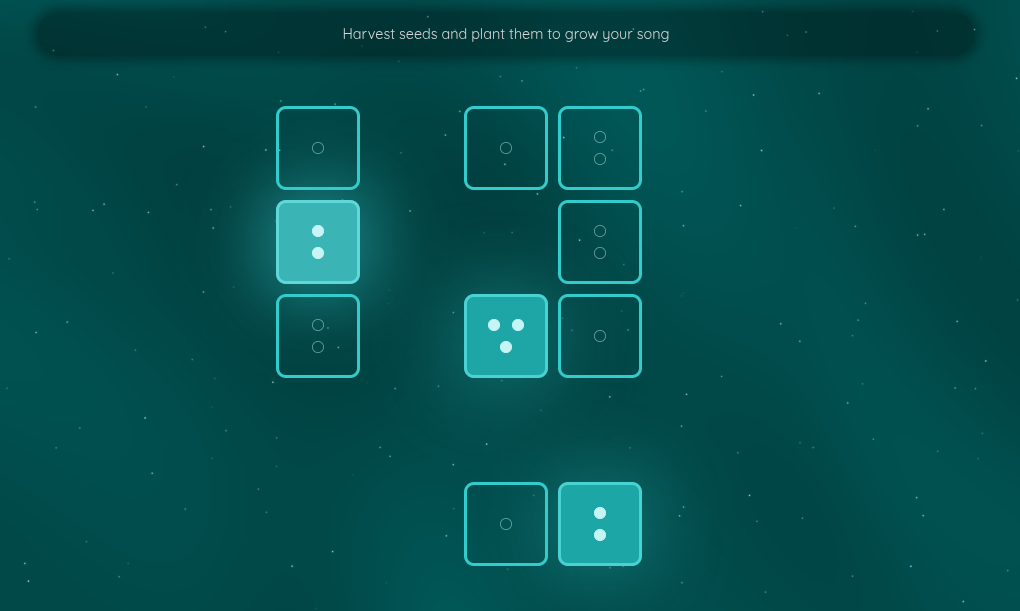
This tutorial is also not intrusive. The text can be ignored if you don’t need it, and it lets you play immediately. In fact, it preserves the quality of the minimalist tutorial: you fully understand the rules only by playing. It’s a nice compromise to let players discover the game by themselves while slightly helping them to understand what they’re doing and nudging them in the right way.
Now there are still some aspects that the tutorial leaves in the dark. It doesn’t explain the action gauge, or that there are several kind of seeds. Some particular rules are hidden, like the bonus seeds or the hidden tiles. But those were designed as small secrets that the player stumbles upon by playing. For some, it’s even okay not to fully understand them, and just get surprised by some results! The ultimate goal is to provide the same experience of mysteries and pleasant surprises to all players. The goal of the tutorial is only to make sure they share a same ground. Giving them a common language to let them explore and solve puzzles by themselves. For all players, I want Starseed Harmonies to feel like a weird toy with hidden mechanisms. And this doesn’t need a guided tour, just instructions on how to start it.
Leave a comment
Log in with itch.io to leave a comment.